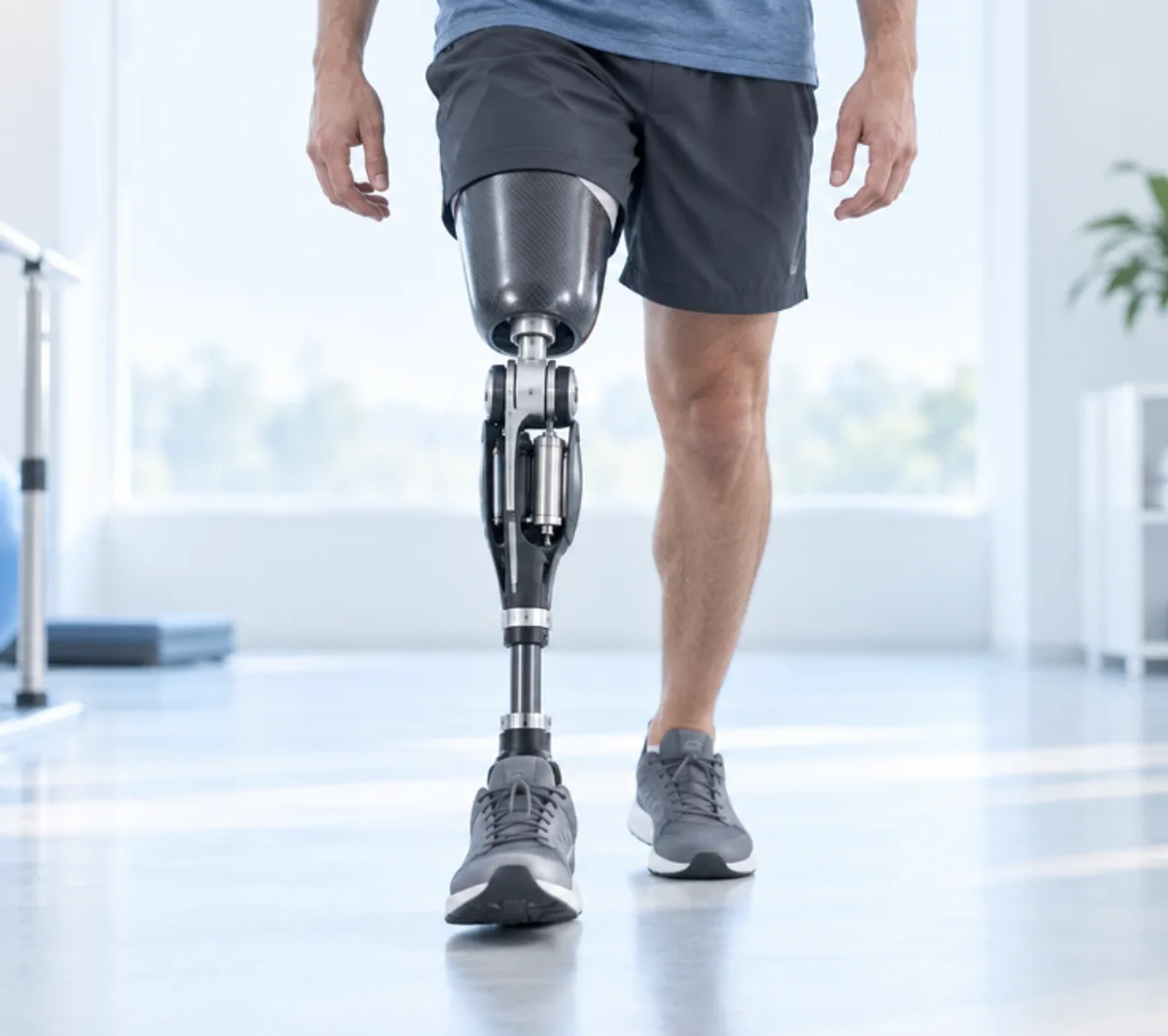
Pneumatic Prosthetic Knee
Pneumatic Prosthetic Knee Fitting and Rehabilitation is a specialized prosthetic service for people with above-knee amputation. Pneumatic knee joints use air-based resistance to help control knee movement, particularly during the swing phase of walking. Different models are available for activity levels ranging from K1 to K4, depending on the patient's mobility needs and the selected knee system.
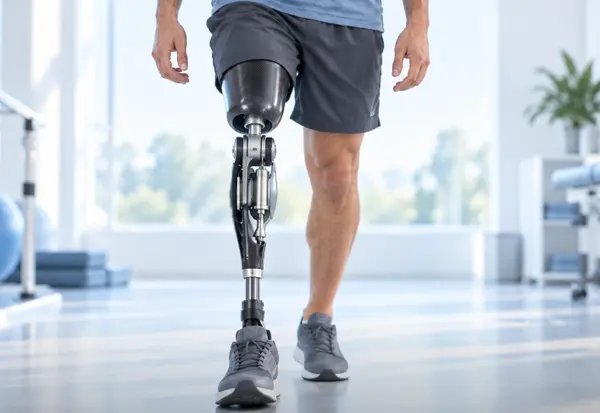
A pneumatic prosthetic knee is an artificial knee joint used as part of an above-knee prosthesis. It uses a pneumatic control system to help regulate knee flexion and extension during walking, particularly as the prosthetic leg moves through the swing phase.
Compared with simpler mechanical systems, pneumatic prosthetic knees can provide smoother and more controlled movement for appropriately selected patients. The level of performance varies according to the design of the knee, the pneumatic control mechanism, the patient's activity level, body weight, balance, muscle strength, and rehabilitation goals.
Pneumatic knee joints are available in both single-axis and polycentric designs. Some models specifically incorporate pneumatic swing-phase control, while others provide different levels of braking and movement control.
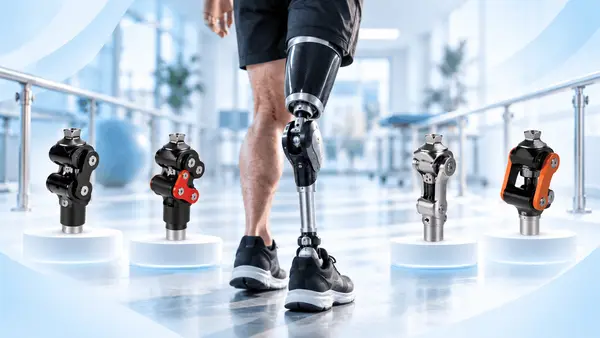
The available pneumatic knee range in the supplied information includes Metiz 6H23 and 6H25, Uniprox JT20 and JT22, and Össur OP4 and OP5.
Successful treatment does not depend on the knee joint alone. The complete prosthetic pathway includes patient assessment, socket fitting, prosthetic component selection, alignment, gait training, rehabilitation, and follow-up adjustments.
A pneumatic prosthetic knee does not treat a disease with conventional symptoms. It is generally considered when a person with an above-knee amputation requires a prosthetic knee that provides appropriate stability and movement control.
A patient may be assessed for pneumatic prosthetic knee fitting when they:
Have undergone an above-knee amputation.
Need a first above-knee prosthesis.
Need replacement or upgrading of an existing prosthetic knee.
Require better control of the prosthetic leg during walking.
Experience difficulty controlling the swing of an existing simpler prosthetic knee.
Need a knee joint matched to a moderate or higher activity level.
Require improved walking performance at different walking speeds.
Need prosthetic gait rehabilitation following amputation.
Require a knee joint matched to their body weight, balance, mobility, and functional goals.
Activity level is an important consideration. The supplied classification describes K1 as low activity, K2 as moderate activity, K3 as moderate-to-high activity, and K4 as high activity involving activities such as running and sports.
Treatment begins with a comprehensive prosthetic and rehabilitation assessment. The prosthetic team evaluates the patient's amputation level, residual limb, body weight, muscle strength, balance, current walking ability, use of mobility aids, previous prosthetic experience, activity level, and functional objectives.
The next step is selecting the appropriate pneumatic knee joint. Different knee systems are designed for different mobility levels and patient characteristics.
The supplied range includes several options.
Metiz 6H23 is a polycentric knee intended for K2/K3 users. It supports patients up to 100 kg and provides knee flexion of up to 150 degrees.
Metiz 6H25 is a polycentric knee for K2/K3 users, supporting patients up to 125 kg with flexion of up to 150 degrees.
Uniprox JT20 is a polycentric knee with pneumatic extension stop and swing-phase control. It is intended for K2 users, supports patients up to 150 kg, and provides flexion up to 135 degrees.
Uniprox JT22 provides higher-control pneumatics and is suitable for K2/K3 users. It supports patients up to 150 kg with flexion up to 135 degrees.
Össur OP4 is a single-axis knee with an adjustable brake function. It is suitable for K1/K2 users, supports patients up to 100 kg, and provides flexion up to 145 degrees.
Össur OP5 is a polycentric knee used for moderate-to-high activity levels K3/K4. It supports patients up to 125 kg and provides flexion up to 145 degrees.
After the knee joint and other prosthetic components are selected, the patient undergoes socket fitting and prosthetic alignment. Proper socket fit is important for comfort, stability, pressure distribution, and control of the prosthetic limb.
Static and dynamic alignment are then adjusted to optimize standing stability and walking performance.
The patient subsequently begins prosthetic rehabilitation and gait training. This may include balance training, weight transfer, standing control, initiation of steps, control of the prosthetic knee during walking, use of walking aids when required, and progressive training across different walking environments.
Follow-up is an important part of treatment. Adjustments may be required as the patient adapts to the prosthesis, the residual limb changes in volume, or walking ability improves.
The goal of pneumatic prosthetic knee fitting and rehabilitation is to provide the patient with a prosthetic system that supports safe mobility, controlled walking, functional independence, and appropriate performance for their individual activity level.
Frequently Asked Questions
Plan for at least 5 days to cover the procedure and initial recovery. Your provider confirms the exact schedule after your medical assessment.
Send a free quotation request and a Macrocare coordinator compares verified providers for Pneumatic Prosthetic Knee, confirms pricing, and arranges appointments, travel and follow-up. Coordination is free for patients.
Pneumatic Prosthetic Knee belongs to Prosthetics & Orthotics. Browse that category to compare related options, their verified providers and real starting prices before deciding.
More in Prosthetics & Orthotics
Compare related options with their verified providers and real starting prices.
Listed prices only — travel and stay are estimated separately. Final cost confirmed on your free quotation. Rates as of 2026-07-20.