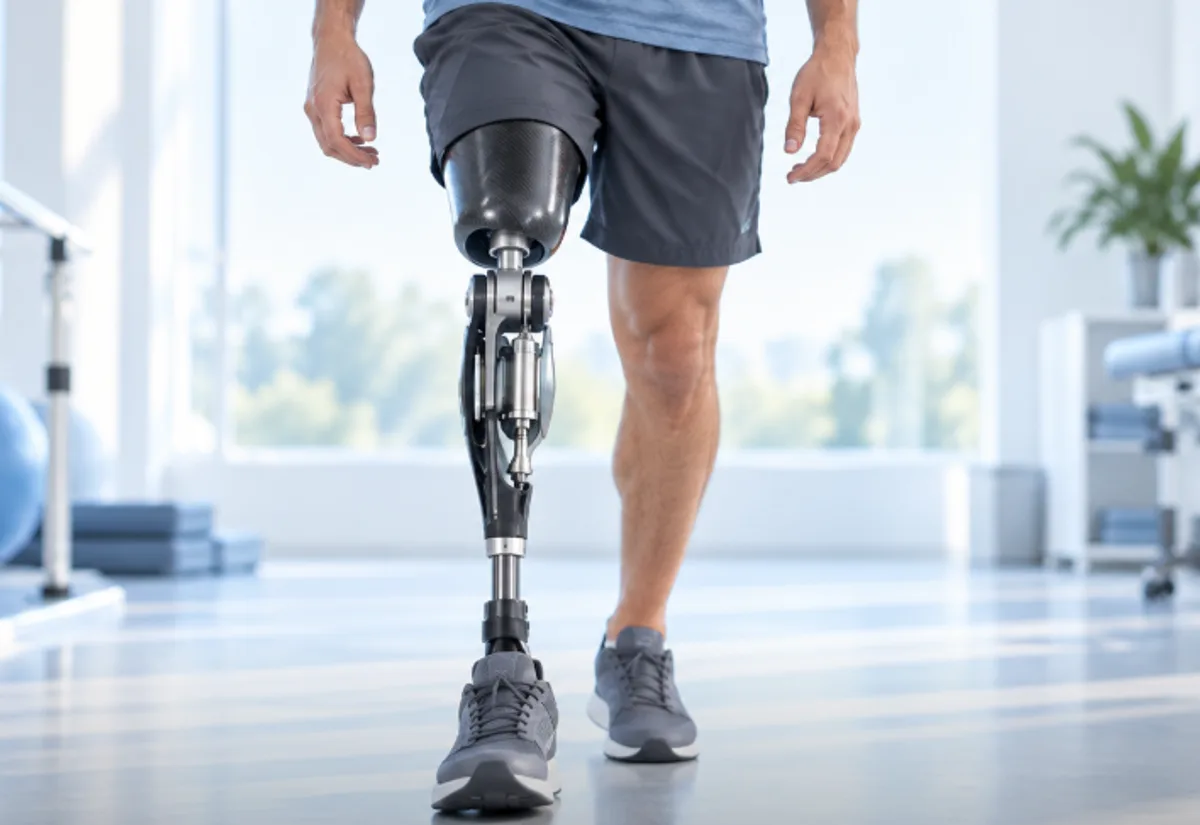
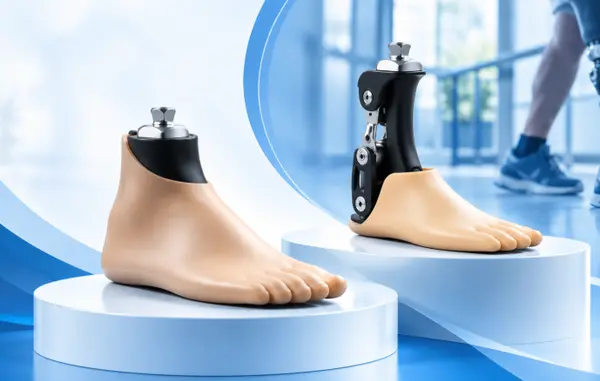
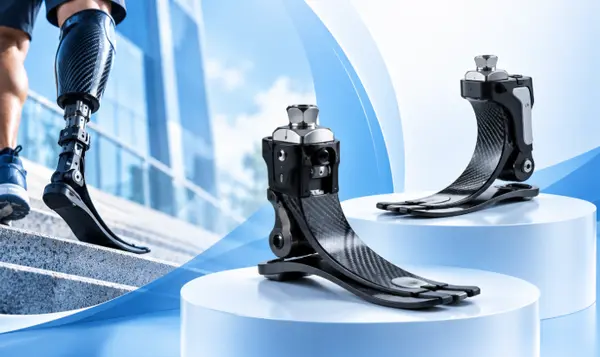
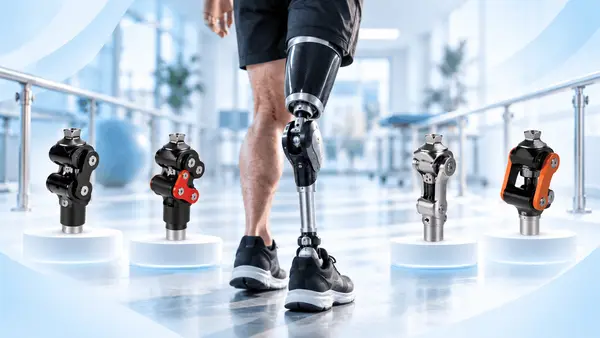
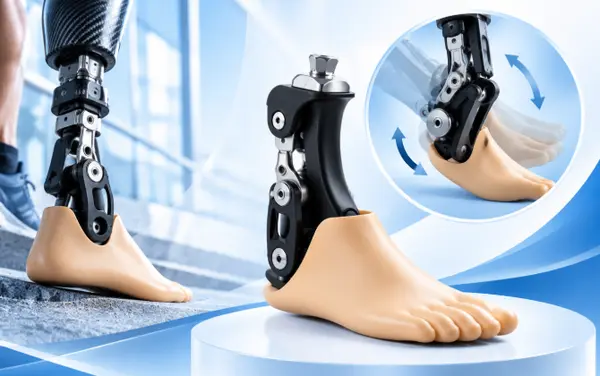
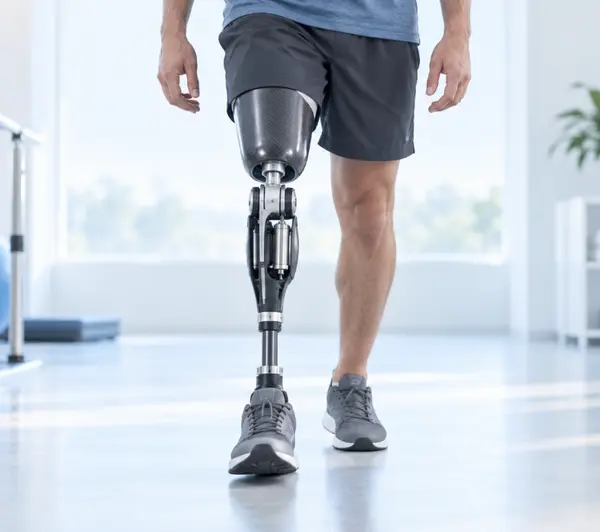
A hydraulic prosthetic knee is an artificial knee joint used as part of an above-knee prosthesis. It is designed to provide controlled knee movement through hydraulic resistance and may be considered for patients who need better regulation of knee flexion and extension during walking.
Hydraulic prosthetic knees are available in several configurations. Depending on the model, they may use a single-axis, monocentric, or polycentric mechanism, with different levels of stance control, swing control, flexion range, patient weight capacity, and activity classification.
The available hydraulic knee range in the supplied source includes Metiz 6H30B, Uniprox JT40, Uniprox JT30, Össur Mauch, Össur Total Knee 1900, Össur Total Knee 2000, and Össur Total Knee 2100. Knee joints Knee joints Knee joints
Who May Need a Hydraulic Prosthetic Knee?
Hydraulic prosthetic knee fitting may be considered for people who have undergone an above-knee amputation and require a prosthetic knee with controlled movement and performance matched to their level of activity.
It may be suitable for patients who have undergone transfemoral or above-knee amputation, need a first prosthetic knee, require replacement or upgrading of an existing prosthetic knee, need improved control during walking, require a knee suited to moderate or high activity, need more controlled stance or swing-phase movement, walk at varying speeds, or require gait training and functional rehabilitation after prosthetic fitting.
Activity Levels K1 to K4
The patient’s activity level is an important part of prosthetic selection.
K1 refers to low activity involving gentle, steady walking, often with the use of a walking aid. K2 refers to moderate activity with average walking and some ability to vary walking speed. K3 refers to moderate-to-high activity and may involve fast walking or jogging. K4 refers to high activity, including running and more demanding physical activity. Knee joints
The hydraulic knees in the supplied range cover several activity levels from K1 through K4 depending on the model. Knee joints Knee joints Knee joints
How Does a Hydraulic Prosthetic Knee Work?
A hydraulic prosthetic knee uses fluid resistance to help regulate movement of the artificial knee joint.
The resistance helps control the speed and pattern of knee flexion and extension during walking. Depending on the design, this can support smoother movement and better adaptation to changes in walking speed.
The degree of control varies significantly between models, so the knee should be selected according to the patient’s mobility level, weight, balance, muscle strength, residual limb condition, walking environment, and rehabilitation goals.
Metiz 6H30B Hydraulic Prosthetic Knee
The Metiz 6H30B is described as a monocentric knee joint intended for highly active K3/K4 users.
According to the supplied specifications, it supports patients up to 125 kg, provides knee flexion up to 150 degrees, and is waterproof. Knee joints
Uniprox JT40 Hydraulic Prosthetic Knee
The Uniprox JT40 is a monocentric hydraulic knee joint with an adjustable extension stop.
It is suitable for K2/K3 users, supports patients up to 100 kg, and provides flexion up to 170 degrees. Knee joints
Uniprox JT30 Hydraulic Prosthetic Knee
The Uniprox JT30 is a polycentric hydraulic knee joint with adjustable stance flexion control.
It is suitable for K2/K3 users, supports patients up to 125 kg, and provides flexion up to 150 degrees. Knee joints
Össur Mauch Knee
The Össur Mauch Knee is described as a single-axis knee intended for highly active K3/K4 users.
It supports patients up to 136 kg and provides flexion up to 115 degrees. Knee joints
Össur Total Knee 2000
The Össur Total Knee 2000 is a polycentric knee designed to provide comfort, natural gait, and shock absorption through adjustable stance flexion.
It is suitable for K3/K4 users, supports patients up to 100 kg, and provides flexion up to 150 degrees. Knee joints
Össur Total Knee 1900
The Össur Total Knee 1900 is a polycentric knee intended for low-impact K1 users.
It supports patients up to 100 kg and provides flexion up to 150 degrees. Knee joints
Össur Total Knee 2100
The Össur Total Knee 2100 is a polycentric knee designed to provide active users with stability and control.
It is suitable for K2/K3/K4 activity levels, supports patients up to 125 kg, and provides flexion up to 150 degrees. Knee joints
Hydraulic Prosthetic Knee Assessment
Before fitting a hydraulic prosthetic knee, the patient should undergo a comprehensive prosthetic and rehabilitation assessment.
The assessment generally considers amputation level, residual limb condition, body weight, muscle strength, balance, current walking ability, use of walking aids, previous prosthetic experience, activity level, lifestyle, home and community environment, functional goals, and expected rehabilitation outcome.
The objective is to select a knee that matches the patient’s real functional requirements rather than choosing a component based only on brand, technology, or price.
Prosthetic Socket Fitting
The hydraulic knee is only one component of the complete above-knee prosthesis.
The prosthetic socket connects the residual limb to the prosthetic system and plays a major role in comfort, stability, pressure distribution, and control.
An advanced knee joint cannot compensate for an uncomfortable or poorly fitted socket. Proper socket design and alignment are therefore essential parts of prosthetic treatment.
Prosthetic Alignment
Once the socket, knee, foot, and other prosthetic components are selected, the prosthesis is aligned.
This generally includes static alignment, dynamic alignment, standing assessment, walking assessment, adjustment of knee behavior, assessment of foot position, and evaluation of the overall gait pattern.
Alignment may need to be adjusted several times as the patient becomes more confident with the prosthesis.
Gait Training with a Hydraulic Prosthetic Knee
Gait training is an important stage of hydraulic prosthetic knee rehabilitation.
The rehabilitation program may include standing balance, weight transfer, step initiation, control of knee flexion and extension, walking at different speeds, turning, walking on different surfaces, stair and obstacle training when appropriate, use of mobility aids when required, and functional activities of daily living.
The rehabilitation plan should be individualized according to the patient’s mobility level and functional objectives.
Hydraulic vs Mechanical Prosthetic Knee
A mechanical prosthetic knee relies primarily on mechanical structures, locks, friction, or geometry to control movement.
A hydraulic knee uses fluid-based resistance to provide more dynamic control of knee movement.
The supplied source classifies prosthetic knees into three major mechanisms: mechanical, pneumatic, and hydraulic. Knee joints
Hydraulic vs Pneumatic Prosthetic Knee
A pneumatic knee uses air resistance, while a hydraulic knee uses fluid resistance.
Both technologies are designed to regulate prosthetic knee movement, but their performance characteristics differ according to model and design.
The choice between hydraulic and pneumatic systems should consider the patient’s mobility level, walking speed, weight, gait pattern, stability requirements, and rehabilitation goals.
Benefits of Hydraulic Prosthetic Knee Fitting
For appropriately selected patients, hydraulic prosthetic knees may support more controlled knee movement, smoother walking, improved adaptation to variable walking speeds, better stance or swing control depending on the model, improved functional mobility, greater walking confidence, and increased independence in daily activities.
The expected benefit depends on correct knee selection, socket fit, alignment, gait training, and ongoing rehabilitation.
Follow-Up After Hydraulic Knee Fitting
Prosthetic care does not end after the initial fitting.
Follow-up may be required to assess socket comfort, residual limb changes, knee settings, prosthetic alignment, walking pattern, balance, activity progression, and the need for component adjustment.
Long-term follow-up helps ensure that the prosthetic system continues to match the patient’s functional needs.
Hydraulic Prosthetic Knee Fitting with Macrocare
Macrocare helps patients access specialized prosthetic and rehabilitation providers for hydraulic prosthetic knee fitting, above-knee prostheses, prosthetic rehabilitation, gait training, and follow-up care.
Patients can compare available options according to activity level, knee mechanism, patient weight, flexion range, knee design, functional requirements, rehabilitation needs, provider availability, and estimated treatment and prosthetic cost.